Fitness Website Redesign Case Study: Oxygen Fitness Club
This fitness website redesign case study shows how we rebuilt a 10,000 sqft premium gym's website from a slow, dated WordPress site into a lightning-fast custom platform — and eliminated every recurring cost in the process.
Key Takeaways at a Glance
- Rebuilt Oxygen Fitness Club's WordPress site as a custom Next.js platform in 3 weeks
- PageSpeed score jumped from 69% (Grade C) to 93/100 — FCP dropped 84% from 2.5s to 0.4s
- Set up 73 redirect rules preserving all SEO rankings with zero loss during migration
- Eliminated $500-$800/year in WordPress hosting and plugin costs (WPForms, hosting, maintenance) — new site costs $0/year
- Built full bilingual support (English + Chinese) and replaced manual trainer workflows with automated tools
- Added O2, a custom bilingual AI concierge (OpenAI gpt-4o-mini) that answers prospect questions and books tours and assessments straight into Calendly — with guardrails, lead logging, and a daily spend cap
About Oxygen Fitness Club: A Premium Markham Gym
Oxygen Fitness Club is a 10,000 sqft premium fitness facility in Markham, Ontario, serving clients from youth athletes to seniors. They offer personal training, group classes, rehabilitation services, and nutrition programs. The facility includes a full gym floor, a lounge area with a pool table, and a recovery zone — a space designed to feel more like a private club than a typical gym.
Their client base is predominantly bilingual (English and Chinese), reflecting Markham's demographics. This meant the website needed to serve both language communities equally well — not as an afterthought, but as a core feature.
Oxygen had been operating with a WordPress website for several years. It served its purpose initially, but as the business grew and the fitness market in Markham became more competitive, the website was becoming a liability rather than an asset.
Why the Old WordPress Gym Website Was Failing
When Oxygen came to us, their WordPress site had four compounding problems that were actively costing them members:
Slow mobile performance losing prospects
The WordPress site had a First Contentful Paint of 2.5 seconds on mobile. In fitness, where over 60% of searches happen on phones, a three-second wait means lost prospects. People Google a gym, tap the first result, wait, and hit the back button. GTmetrix rated the site a C with 69% performance — failing every Core Web Vital metric that Google uses for search rankings.
Dated design mismatching the brand
The physical space at Oxygen is premium — LED-lit training areas, a lounge with a pool table, professional equipment from Technogym and Precor. But the website looked like a generic 2018 WordPress theme. The first impression online did not match the experience inside. For a facility charging premium rates, this disconnect was eroding trust before prospects even walked through the door.
Plugin maintenance and security risks
The WordPress site ran 10+ plugins for basic functionality — WPForms for contact forms, Yoast for SEO, caching plugins, image optimization, security. Every plugin update risked breaking something. The site owner had no way to fix these issues without calling a developer. Annual costs for hosting and premium plugin subscriptions (WPForms Pro alone is $199/year) added up to $500-$800 per year — a recurring expense for functionality that should just work out of the box.
Manual trainer workflows draining staff time
Behind the scenes, the gym's operational tools were equally fragmented. Trainer session intake forms were handled through Jotform, routed through Make.com automations into Google Sheets, then manually processed into client reports. This pipeline broke silently every time a form field was updated. Staff were spending 30+ minutes per client report on manual copy-paste work.
Sound like your website? Get a free audit.
Get Your Free AuditOur Fitness Website Redesign Process
We treated this as a full digital transformation, not just a website redesign. The project was broken into four phases over three weeks:
Discovery & Audit
We audited the existing WordPress site's performance (GTmetrix, PageSpeed Insights), cataloged every page and URL, mapped the trainer workflow pipeline, and identified every plugin and third-party dependency. We documented 73 unique URLs that would need 301 redirects to preserve SEO equity.
Design & Architecture
We designed a mobile-first, dark-themed interface that matches Oxygen's premium positioning. The color system uses deep navy and charcoal with cyan accents — deliberately moving away from the loud reds and oranges typical of fitness websites. Every image was shot specifically for the brand, no stock photos.
Development & Migration
We built the site from scratch using Next.js with server-side rendering, deployed on Vercel's edge network. All content was migrated, images were converted from JPG/PNG (200-400KB each) to optimized WebP format (30-80KB each). Bilingual support was built as a core feature, not a plugin. We created custom intake forms that submit directly to a secure database, eliminating the Jotform + Make.com + Google Sheets pipeline entirely.
SEO Migration & Launch
We configured 73 redirect rules mapping every old WordPress URL to its new equivalent — trainer pages, product pages, service pages, and WooCommerce routes. The site was submitted to Google Search Console, and all pages were fully indexed within two weeks of launch with zero ranking loss.
Custom Gym Website Features and Build Details
The new site is not a template or a theme. Every component was purpose-built for Oxygen's specific needs. The homepage features a full-bleed image carousel showcasing the actual facility — the training floor, the lounge area, the recovery zone. The hero section leads with their positioning statement and two clear calls to action: Join Now and Book a Tour.
The trainers page is designed to build trust. It opens with a team group photo, then features individual trainer cards with professional portraits, bios, and specializations. Visitors can see the real people they would be working with before they ever walk through the door. A transformations section shows real client results with before-and-after photos.
The pricing page is radically transparent. Where most gym websites hide pricing behind a "Contact Us" button, Oxygen displays every membership tier, training package, meal plan, and add-on with exact prices. This transparency is a deliberate conversion strategy — it filters out price-sensitive prospects and pre-qualifies visitors who do reach out.
Bilingual support is integrated at the infrastructure level, not bolted on with a translation plugin. A language toggle in the navbar switches between English and Chinese instantly, with all content — including forms, pricing tables, trainer bios, and navigation — fully translated. This serves Markham's large Chinese-speaking community and gives Oxygen a competitive advantage over gyms that only offer English.
After the initial launch, we extended the platform with O2 — a custom AI concierge built on OpenAI's gpt-4o-mini. O2 sits in the corner of every page and answers real prospect questions about memberships, pricing, hours, trainers, and classes, in both English and Chinese. It is page-aware — on the pricing page it leads with the numbers; on the trainers page it points visitors toward a free assessment — and it is wired into Calendly, so a conversation can turn into a booked tour or assessment without leaving the chat. Crucially, O2 is built on guardrails: it draws only from the studio's real knowledge base — actual prices, real trainer names, current promotions — and is explicitly prevented from inventing details. Every conversation is logged to an admin leads board so the team can see exactly what prospects are asking, and a daily spend cap plus an instant kill switch keep AI costs predictable.
We also added a service recommendation engine that pairs a visitor's goals, experience, and constraints with the right membership or training package, and an admin leads board that ties every chat, recommendation, and Calendly booking back to a single contact — turning the website from a brochure into a working sales tool.
Gym Website Redesign: Before and After Screenshots
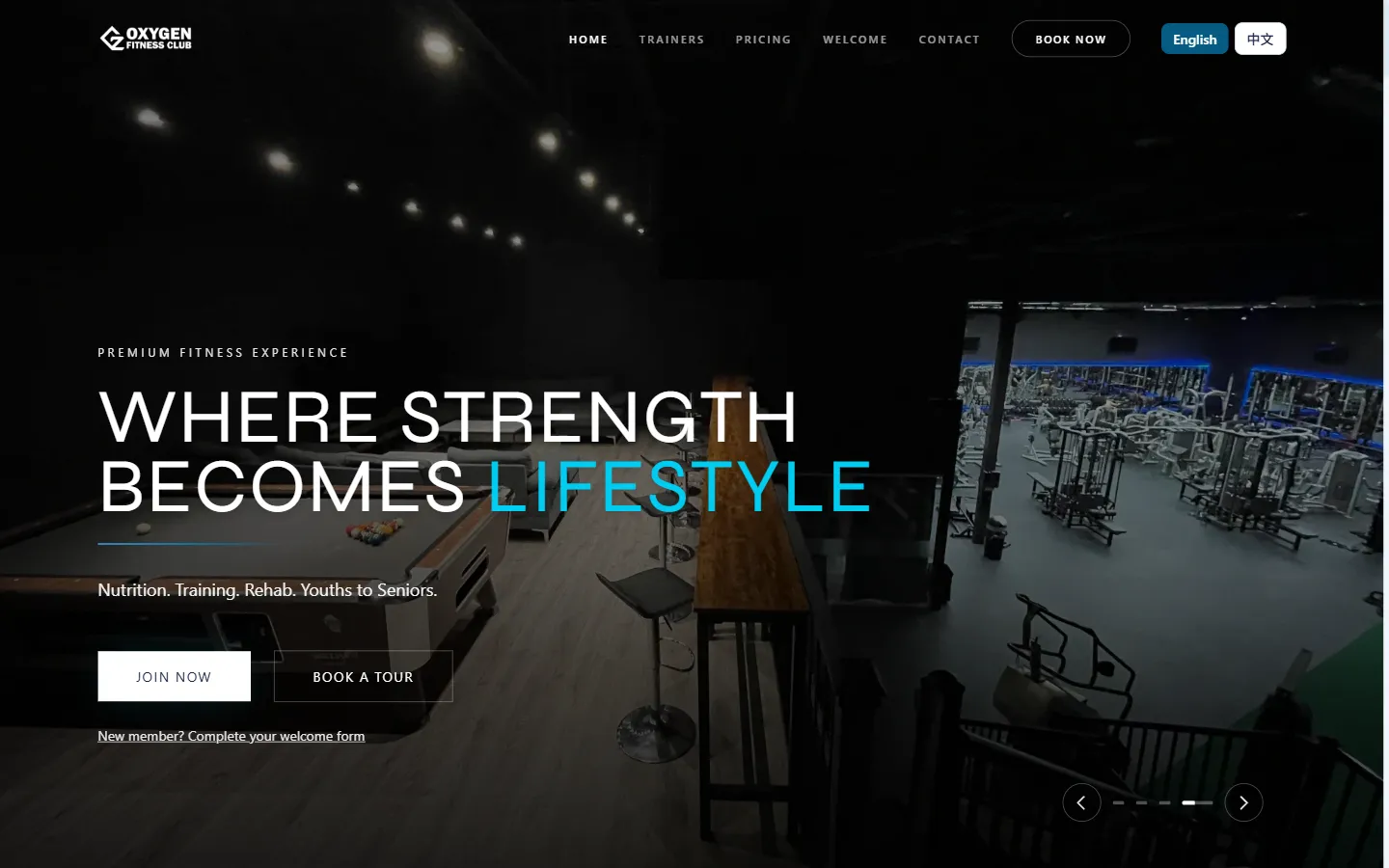
New homepage: full-bleed facility carousel, clear CTAs, premium dark aesthetic
Why We Chose Next.js Over WordPress for This Gym Website
WordPress powers 43% of the web, and for good reason — it is the most accessible website platform ever built. But for a premium fitness facility competing for local search visibility, WordPress had become the bottleneck. The question was not whether WordPress could build a gym website, but whether it could build one fast enough to compete.
Next.js solved every problem WordPress created for Oxygen. Server-side rendering means Google sees fully rendered HTML on the first crawl — no waiting for JavaScript to execute, no render-blocking plugins. The page loads in under a second because the HTML is prebuilt and served from Vercel's edge network, which has data centers in Toronto. WordPress, by comparison, was generating pages dynamically on each request through PHP, adding latency at every step.
The image optimization alone justified the switch. WordPress required a plugin (Smush, ShortPixel, or similar) to compress images, and even then served them as JPGs or PNGs. Next.js Image component automatically converts uploads to WebP, resizes them per device, and lazy-loads below-the-fold images — all without a plugin. This dropped Oxygen's image payloads from 200-400KB to 30-80KB per image.
For a local business, the performance difference is not abstract. Google uses Core Web Vitals as a ranking signal for local search. A gym website that loads in under one second on a phone outranks one that takes three seconds — and that gap directly translates into which gym shows up when someone searches 'personal training near me' in Markham.
Fitness Website Redesign Results: Before and After
The performance improvement was immediate and measurable. We tested the old WordPress site on GTmetrix (January 22, 2026) and benchmarked the new Next.js site on Google PageSpeed Insights after launch:
| Metric | Before (WordPress) | After (Next.js) | Change |
|---|---|---|---|
| Performance Score | 69% (Grade C) | 93/100 | +24 points |
| First Contentful Paint | 2.5s | 0.4s | 84% faster |
| Largest Contentful Paint | 1.8s | 1.0s | 44% faster |
| Total Blocking Time | 374ms | 170ms | 55% faster |
| Cumulative Layout Shift | 0.02 | 0 | Perfect |
| Best Practices | N/A | 100/100 | Perfect |
| SEO Score | N/A | 100/100 | Perfect |
| Accessibility Score | N/A | 96/100 | Excellent |
Key Takeaways for Gym Owners Considering a Website Redesign
Your website speed directly affects your search ranking
Google uses Core Web Vitals as a ranking factor. If your gym website takes more than 2 seconds to load on mobile, you are losing position to faster competitors. Run your site through Google PageSpeed Insights — if you score below 80, a redesign will likely pay for itself through improved local search visibility.
Plan your URL redirects before you touch anything else
The biggest risk in any website migration is losing existing SEO equity. We mapped all 73 of Oxygen's WordPress URLs before writing a single line of code, and set up 301 redirects (permanent forwarding rules that tell Google the page has moved) for every one. The result: zero ranking loss. Skip this step and you could lose years of accumulated search authority overnight.
Bilingual is a competitive advantage, not a nice-to-have
In markets like Markham where a significant portion of the population speaks Chinese, offering a fully translated website is not just courtesy — it is a business strategy. Most competing gyms in the area only offer English. Oxygen's bilingual site serves a market that competitors are ignoring.
Eliminate recurring costs, do not just reduce them
WordPress maintenance costs compound silently — hosting, plugin renewals like WPForms Pro ($199/year), security patches, developer fixes. Oxygen was spending $500-$800 per year on these. The custom site eliminated all of them permanently. Over five years, that is $2,500-$4,000 saved, which means the custom build effectively pays for itself.
Want Results Like These?
Every project starts with a free discovery call. No sales pitch — just an honest assessment of whether a custom website makes sense for your business, or if optimizing what you have is the better move. You own the code, the domain, and the content. No lock-in, no recurring fees.
Book a Free Discovery CallTech Stack: Why Next.js for Fitness Websites
Frequently Asked Questions
How much does a fitness website redesign cost?
A complete website redesign like the Oxygen Fitness Club project falls in our Digital Foundation package, starting at $2,000. This includes design, development, content migration, SEO redirect setup, and deployment. There are no ongoing hosting or plugin fees after launch — the site runs on Vercel's free tier. Compare that to WordPress where you are paying $500-$800 per year on hosting and plugin subscriptions like WPForms Pro just to keep the lights on.
How long does a website redesign take?
The Oxygen Fitness Club project was completed in 3 weeks from kickoff to launch. This included discovery, design, development, content migration, 73 redirect rules, bilingual content, and deployment. Most similar projects follow the same 2-4 week timeline. Unlike WordPress projects, there is no post-launch period of installing plugins, configuring caching, and troubleshooting theme conflicts.
Will I lose my Google rankings during the migration?
No. We set up 301 redirect rules (permanent forwarding rules that tell Google the page has moved) for every existing URL before launch. For Oxygen, that meant 73 individual redirects covering trainer pages, product pages, service pages, and WooCommerce routes. The new site was fully indexed by Google within two weeks with zero ranking loss. We also submit the new sitemap to Google Search Console and monitor indexing until all pages are covered.
How do you measure the ROI of a website redesign?
ROI comes from three places: reduced costs, improved search visibility, and higher conversion rates. For Oxygen, we eliminated $500-$800 per year in WordPress hosting and plugin subscriptions (WPForms Pro, hosting, maintenance), plus 10+ hours per week in manual staff work (calculated from 20 clients at 30+ minutes per manual report). The 84% improvement in page load speed directly improves Google ranking position for local search — where the majority of gym memberships originate. Over five years, the cost savings alone mean the custom build pays for itself.
What features should a fitness website have?
A modern fitness website needs fast mobile loading (under 2 seconds), a trainer showcase with real photos and bios, transparent pricing (not hidden behind a Contact Us button), an online booking or contact flow, and responsive design that works on every device. If you serve a multilingual community, built-in language support is a major competitive advantage. The Oxygen Fitness Club site includes all of these plus automated intake forms and client reporting tools.
Is Next.js better than WordPress for gym websites?
For performance-focused gym websites, yes. Next.js serves prerendered pages from edge servers, meaning your site loads in under a second without caching plugins or CDN configuration. WordPress generates pages dynamically through PHP, which is inherently slower. The Oxygen rebuild showed a 84% improvement in First Contentful Paint. However, if you run a content-heavy blog with multiple non-technical writers publishing daily, WordPress's editorial workflow is still hard to beat.
What happens after launch? Do you offer ongoing support?
Yes. After launch, you own the code, the domain, and all content — there is zero vendor lock-in. For ongoing support, our retainer plans start at $300 per month and include same-day content updates, bug fixes, and performance monitoring. If anything breaks, we fix it. Many clients do not need a retainer at all because the custom site has no plugins to update and no security patches to apply — it just runs.
Do you build websites for other industries, or just fitness?
We build custom websites for any small business that has outgrown WordPress or template-based solutions. Fitness is one vertical — we also work with professional services, e-commerce, SaaS companies, and local businesses. The same principles apply: fast loading, mobile-first design, zero plugin maintenance, and a site that actually converts visitors into customers.
What happens to my WordPress content during the migration?
We handle the full content migration as part of the project. All existing text, images, and page structure are transferred to the new site. Images are converted to optimized WebP format — the Oxygen migration reduced image sizes by 70-80% while maintaining quality. Nothing is lost in the transition.
Can you add an AI chatbot or assistant to my website?
Yes — we built one for Oxygen. O2 is a custom AI concierge (powered by OpenAI's gpt-4o-mini) that answers prospect questions about memberships, pricing, hours, and trainers in English and Chinese, then books a tour or assessment through Calendly. It uses only the studio's real information — actual prices, real trainer names, current promotions — and is built so it cannot invent details. Every conversation is logged so the team sees what prospects want, and a daily spend cap keeps costs controlled. Unlike a generic chatbot plugin, it is tailored to the business, its booking flow, and its brand.
Ready to Build?
Book a free 20-minute consultation. We'll map your needs, recommend the right package, and give you a clear timeline.